India’s air conditioning market has entered a phase of explosive growth that shows no signs of slowing. Valued at approximately USD 6.15 billion in 2025 and projected to reach USD 15.4 billion by 2031 at a CAGR of 10-12%, the Indian AC market is being propelled by forces that are structural rather than cyclical — rising temperatures pushing deeper into previously mild regions, growing urban incomes making air conditioning affordable for an expanding middle class, and rapid urbanisation creating dense housing where cross-ventilation alone no longer provides adequate cooling.
Over 80% of new AC sales in 2026 are inverter models, as consumers have decisively shifted from fixed-speed compressors toward energy-efficient inverter technology that delivers lower electricity bills and more precise temperature control. Smart features — AI-enabled cooling, Wi-Fi control, air purification filters — have moved from premium novelty to mid-range expectation. And the top five brands collectively capture the overwhelming majority of a market where brand trust, service network reach, and energy efficiency credentials matter enormously to consumers making a purchase they expect to last a decade or more.
India AC Market Overview 2026
Room air conditioners constitute approximately 48% of India’s total AC market, with 1.5-ton split inverter models dominating consumer demand. The residential segment accounts for 44% of total AC demand, followed by commercial and retail at 24.3%, hospitality at 14.7%, and healthcare at 11.6%. North India represents the single largest regional market at approximately 29% share, driven by extreme summer temperatures that push ambient conditions above 45°C for extended periods.
A significant 2026 development is the updated BEE (Bureau of Energy Efficiency) star-rating norms, which have tightened energy efficiency requirements across all AC categories — meaning a 5-star rated 2026 model is meaningfully more efficient than a 5-star model from just two years earlier, making star rating comparisons across model years less straightforward than consumers might assume.
1. Voltas — India’s Best-Selling AC Brand
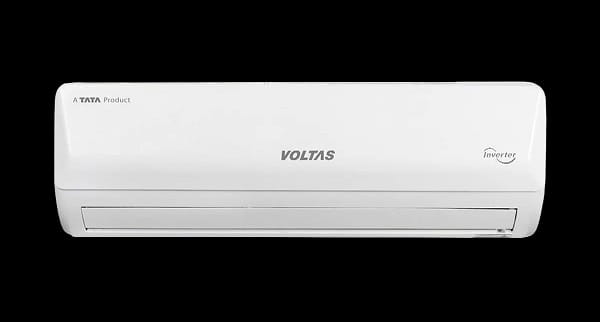
Voltas — a Tata Group company — leads India’s room air conditioner market with approximately 18-19.5% market share, having sold over 2 million AC units in FY2024 alone, the highest annual sales by any single brand in India’s history. This market leadership is built on three pillars: the Tata Group’s unmatched brand trust among Indian consumers, the widest AC service network in the country covering cities, towns, and semi-urban areas where competitors simply have no presence, and consistently competitive pricing that makes Voltas the default choice for India’s vast middle-market consumer base.
Voltas designs its products specifically for Indian conditions rather than adapting global platforms — a seemingly obvious but genuinely differentiating approach that results in ACs optimised for India’s specific dust levels, voltage fluctuations, humidity patterns, and extreme temperature ranges. The 2026 Vertis AI-powered series represents Voltas’ entry into the premium smart AC segment, featuring adaptive cooling that adjusts based on room occupancy and ambient conditions.
The Maha Adjustable Inverter technology — allowing users to switch cooling capacity across five levels depending on room occupancy — provides genuine energy savings for Indian households where a living room might host a family of six during the evening and a single person during the afternoon. Voltas projects 15-20% sales growth for 2026, though anticipated price hikes of 5-15% due to rising copper costs and new energy efficiency mandates will test the price-value equation the brand has historically dominated.
Market share: ~18-19.5%. Best for: Budget to mid-range buyers, Tier-2 and Tier-3 cities, widest service network in India.
2. LG — The Smart AC Leader
LG holds approximately 18% of India’s AC market — effectively tied with Voltas for the leadership position, though the two brands serve meaningfully different consumer segments. Where Voltas dominates the value and mid-range space, LG has built its position on technology differentiation, smart features, and premium positioning that appeals to tech-savvy urban consumers willing to pay more for advanced functionality.
LG’s Dual Inverter compressor technology uses two rotary cylinders to reduce vibration and noise, making LG ACs consistently among the quietest units available in the Indian market — a genuinely important differentiator for bedrooms and study rooms. The Ocean Black Protection coating specifically addresses corrosion from salty coastal air, making LG the preferred brand in Mumbai, Chennai, and other coastal cities where standard coils deteriorate faster.
The 2026 Essential Series launch features Smart Inverter Compressor technology with variable tonnage operation — the ability to automatically adjust cooling capacity based on real-time room conditions rather than running at fixed output. LG’s ThinQ app integration allows remote operation, energy monitoring, and diagnostic alerts through smartphone, positioning LG at the forefront of the connected home AC category.
Market share: ~18%. Best for: Smart home integration, low noise operation, coastal cities, tech-forward urban consumers.
3. Daikin — The Premium Technology Champion
Daikin — the Japanese company that invented inverter air conditioning technology — holds approximately 15-17.5% of India’s AC market and is widely regarded by HVAC professionals and AC technicians as the most durable, most technically refined brand available. When AC technicians are asked which brand they would install in their own homes, Daikin is consistently the most frequently cited answer — a powerful, if anecdotal, endorsement of the brand’s engineering quality.
Daikin’s core technological advantage is its PM (Permanent Magnet) inverter compressor, which adjusts speed continuously rather than cycling between fixed output levels, delivering more precise temperature control, lower electricity consumption, and significantly longer compressor lifespan than conventional inverter designs. This technology, combined with Daikin’s insistence on 100% copper coils (rather than the aluminium coils some competitors use to reduce costs), creates a durability advantage that manifests over the AC’s full 12-15 year expected lifespan.
A major 2026 development: Daikin announced a ₹1,000 crore investment to establish its first global R&D centre outside Japan, located in India, focusing on advanced HVAC and data centre cooling solutions. This investment signals Daikin’s long-term commitment to the Indian market and positions India as a core innovation hub rather than merely a manufacturing and sales territory.
Market share: ~15-17.5%. Best for: Premium buyers prioritising durability and long-term reliability, extreme heat regions, commercial and residential applications.
4. Blue Star — India’s Premium Cooling Specialist
Blue Star has grown from a predominantly commercial and industrial cooling company into one of India’s most respected residential AC brands, currently holding approximately 14.3% market share in room air conditioners with an explicit target of reaching 14.75% by FY27. The brand entered the residential segment only in 2011 and has built its position through premium positioning, superior build quality, and a product range specifically designed for demanding cooling conditions.
Blue Star has introduced 125 new models in 2026, including an expanded inverter and window AC range, with products available at 10,000 outlets across 900 towns. The brand’s heritage in commercial cooling — designing and installing air conditioning for offices, hospitals, hotels, and large commercial spaces — informs its residential products with an engineering rigour that purely consumer-focused brands don’t always match.
For consumers seeking heavy-duty cooling for large rooms, high-ceiling spaces, or areas with particularly demanding heat conditions, Blue Star’s higher-capacity models deliver cooling performance that justifies their premium pricing. The brand also performs strongly in dehumidification and air filtration — features increasingly valued by health-conscious consumers.
Market share: ~14.3%. Best for: Premium residential cooling, large rooms, consumers prioritising build quality and advanced air filtration.
5. Samsung — The Innovation and Design Contender
Samsung holds approximately 10% of India’s AC market and has distinguished itself in 2026 through the Bespoke AI WindFree lineup — ACs that distribute cooled air through thousands of micro-holes rather than direct airflow, eliminating the uncomfortable “cold draft” sensation that conventional ACs produce. This WindFree technology, combined with Samsung’s AI-powered cooling algorithms that learn household usage patterns and adjust operations accordingly, positions Samsung uniquely among brands targeting health-conscious, design-aware consumers.
Samsung’s room AC sales reportedly doubled in the first quarter of 2025, reflecting strong consumer response to the WindFree concept and the brand’s broader integration with Samsung’s connected home ecosystem — SmartThings allows seamless control of Samsung ACs alongside other Samsung appliances through a single app interface.
The brand’s digital inverter compressor carries a 10-year warranty — among the longest in the Indian market — and its anti-corrosion Durafin Ultra coating provides protection against salt, sand, and industrial pollutants. Samsung’s positioning is distinctly premium-urban, appealing to consumers who value design aesthetics and smart home integration alongside cooling performance.
Market share: ~10%. Best for: Design-conscious consumers, WindFree gentle cooling, smart home ecosystem integration, health-focused air distribution.
How to Choose the Right AC in 2026
The practical decision framework for Indian consumers in 2026: match tonnage to room size (1 ton for up to 120 sq ft, 1.5 ton for 120-180 sq ft, 2 ton for larger spaces); always choose inverter over fixed-speed (energy savings pay back the higher upfront cost within 1-2 years of regular use); prioritise 5-star BEE rating if you run the AC more than 4 hours daily; insist on 100% copper coils for better heat exchange and easier repair; and verify service centre availability in your specific location before purchasing, since after-sales service quality varies dramatically between brands and between cities.
FAQs
Q: Which AC brand has the highest market share in India in 2026?
A: Voltas leads with approximately 18-19.5% market share, closely followed by LG at approximately 18%. Daikin holds approximately 15-17.5%, Blue Star approximately 14.3%, and Samsung approximately 10%. Together, these five brands capture the substantial majority of India’s room AC market.
Q: Is a 5-star AC worth the extra cost over a 3-star model?
A: For consumers running their AC more than 4 hours daily during summer months, a 5-star inverter AC typically recovers its higher purchase price through electricity savings within 1-2 years. Over the AC’s expected 10-15 year lifespan, cumulative electricity savings of ₹15,000-25,000 make the higher-rated model financially superior despite the higher initial investment.
Q: Which AC brand is best for extreme heat conditions above 45°C?
A: Daikin and Blue Star are most consistently recommended for extreme heat regions, with both brands specifically engineering their products for ambient temperatures crossing 50°C. Daikin’s continuous-speed PM inverter compressor and Blue Star’s commercial-grade cooling heritage provide superior performance in conditions that push standard residential ACs to their limits.
Q: How long does a good AC last in Indian conditions?
A: A well-maintained inverter AC from a premium brand like Daikin, LG, or Blue Star typically lasts 12-15 years in Indian conditions. Budget-range ACs typically last 7-10 years. Annual servicing — filter cleaning, refrigerant check, drain clearing — is essential for maximising lifespan in India’s dusty, humid climate.
Q: Should I choose copper or aluminium coils?
A: Always opt for 100% copper coils if your budget allows. Copper offers superior heat exchange properties (better cooling efficiency), greater corrosion resistance, and significantly easier repair compared to aluminium — a field technician can repair a copper coil on-site, while aluminium coils typically require full replacement. The price difference is justified by the longer operational life and lower maintenance costs over the AC’s full lifespan.