The oven has undergone a quiet revolution in Indian kitchens over the past decade. Once considered a niche Western appliance with limited relevance to Indian cooking, ovens — particularly convection microwave ovens — have become genuinely mainstream in urban Indian households, driven by a generation of home cooks who bake cakes for family birthdays, grill paneer tikka without a tandoor, roast vegetables for healthier meals, and use auto-cook presets for everything from making curd to reheating yesterday’s biryani. In 2026, the convection microwave oven segment specifically is the fastest-growing kitchen appliance category in India, as consumers increasingly prefer a single multifunctional device that bakes, grills, roasts, reheats, and defrost over purchasing separate OTGs and standalone microwaves.
The Indian oven market in 2026 spans three main categories: solo microwave ovens (basic reheating and cooking), convection microwave ovens (baking, grilling, roasting, and reheating in a single unit), and OTGs (Oven-Toaster-Grills, dedicated baking and grilling appliances without microwave functionality). The five brands below dominate the market across these categories, each with specific strengths that match different Indian cooking needs.
1. LG — India’s Most Versatile Oven Brand
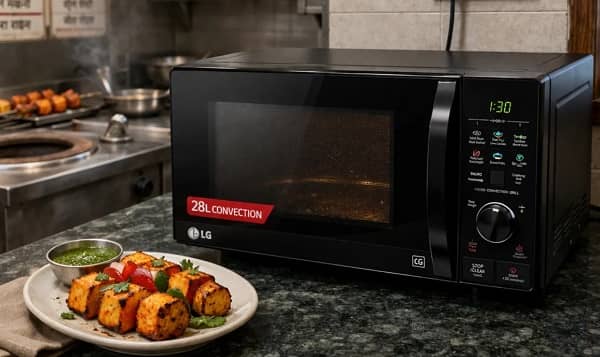
LG dominates the premium convection microwave oven segment in India with Smart Inverter Technology that delivers precise, energy-efficient cooking across all modes — microwave, convection, grill, and combination. The brand’s Charcoal Lighting Heater technology represents a genuinely distinctive innovation: using charcoal-element heating for convection baking and grilling, it produces more even browning and closer-to-tandoor-style results than the conventional metal heating elements most competitors use.
The LG 28L Convection (MC2886BRUM) is widely considered the best convection microwave oven for baking in India in 2026 — its 28-litre cavity comfortably accommodates standard 8-inch baking tins with sufficient space for hot air circulation, preventing the “sunken middle” problem that plagues cake baking in smaller or less well-engineered ovens. The 2,100W convection power delivers fast, even preheating and consistent temperature maintenance throughout the baking cycle.
LG’s auto-cook menu library includes 250-plus Indian recipes with one-touch presets for tandoori, biryani, paneer dishes, and curd making — the last of these being genuinely useful in Indian households where homemade curd is a daily requirement. The stainless steel cavity resists odour absorption and staining, maintaining hygiene across years of diverse cooking use. The Diet Fry feature and roti basket accessory further tailor LG’s oven lineup to specifically Indian cooking patterns.
Capacity range: 20L-32L. Price range: ₹8,000-₹20,000. Best for: Home baking, versatile Indian cooking, charcoal-style browning, Healthy Heart menus, premium kitchen integration.
2. Samsung — The Innovation and Crisping Champion
Samsung’s convection microwave oven range brings two genuinely distinctive technologies to the Indian market that differentiate it from all competitors. HotBlast technology directs powerful hot air downward through multiple openings in the oven ceiling, producing dramatically faster and more even browning on top surfaces — particularly transformative for dishes like gratins, tandoori preparations, and baked cheese toppings that need strong top-browning. SlimFry technology enables crispy, fried-texture results using minimal or no oil — genuinely useful for health-conscious Indian families who want samosa-like crispiness without deep frying.
The Samsung 28L Convection (MC28A5013AK/TL) features Tandoor technology and a dedicated Curd Making mode — two India-specific presets that reflect Samsung’s investment in understanding and engineering for actual Indian cooking patterns rather than simply rebadging Western-market products. The ceramic enamel interior resists scratching and staining significantly better than painted steel cavities, making daily cleaning notably easier over the oven’s multi-year lifespan.
Samsung’s masala and sun-dry presets, alongside dough-proofing functionality, demonstrate a product development approach that has genuinely studied Indian kitchen workflows. The HotBlast temperature range spanning 40°C to 200°C provides fine-grained control for everything from gentle yogurt fermentation to high-heat pizza baking.
Capacity range: 23L-32L. Price range: ₹9,000-₹22,000. Best for: Crispy healthy cooking with minimal oil, tandoori-style preparations, curd making, buyers prioritising top-browning performance.
3. IFB — India’s Indian-Cooking Specialist
IFB (Indian Fine Blanks) occupies a genuinely distinctive position in the Indian oven market — the brand most specifically and deliberately designed for Indian cooking applications, with auto-cook libraries, cavity designs, and cooking modes engineered from the ground up for the unique demands of Indian cuisine rather than adapted from Western-market platforms. For buyers whose primary use cases are Indian food preparation — kebabs, tandoori, biryani, curd, paneer dishes, rotis — IFB delivers the most contextually relevant cooking experience.
The IFB 30BRC2 30L Combination model is widely considered the best combination microwave oven in India under ₹20,000 — featuring 101 Indian auto-cook menus, rotisserie function, multi-stage cooking (allowing different power levels across a single cook cycle), and a steam-clean function that simplifies maintenance. The multi-stage cooking capability is particularly valuable for Indian dishes that require initial high-power cooking followed by extended low-power simmering — a sequence that single-stage ovens cannot automate.
IFB’s stainless steel cavity is standard across most models (unlike competitors where stainless cavities are often reserved for premium-priced models), providing better durability, hygiene, and odour resistance. The brand’s product range spans 20L to 36L, with the larger capacities specifically accommodating the bigger cooking vessels and batch cooking that larger Indian families require.
Capacity range: 20L-36L. Price range: ₹7,000-₹22,000. Best for: Indian recipe-focused cooking, multi-stage cooking, rotisserie and kebab preparation, buyers seeking Indian-engineered functionality at competitive pricing.
4. Panasonic — The Even-Heating Reliability Champion
Panasonic brings Japanese precision engineering to the Indian oven market, with a specific reputation for the most even, consistent heating performance across the cavity — the characteristic that matters most for baking, where hot spots produce unevenly cooked results that frustrate home bakers regardless of recipe quality. The brand’s 360-degree Heat Wrap technology distributes heat uniformly from all directions simultaneously, preventing the common problem of overcooked edges and undercooked centres.
The Panasonic 27L Convection (NN-CT645BFDG) combines convection baking, Magic Grill operation, and user-friendly digital controls at mid-range pricing — positioning it as the reliability-focused alternative for buyers who prioritise consistent cooking outcomes over the latest smart features. Panasonic’s inverter technology delivers precise power control that improves defrosting (no more partially cooked edges on frozen food) and reheating (no more rubbery, overheated spots alongside cold centres).
Panasonic’s strength is durability and long-term reliable performance — the brand’s ovens consistently receive positive user reviews for maintained quality over extended ownership periods, with fewer reported component failures than many competitors in the same price range. Service network coverage is adequate across metros and larger Tier-2 cities, though somewhat thinner than LG and Samsung in smaller towns.
Capacity range: 20L-30L. Price range: ₹7,000-₹18,000. Best for: Consistent even baking, reliable defrosting and reheating, buyers prioritising long-term durability, precise temperature control.
5. Whirlpool — Smart Features at Value Pricing
Whirlpool rounds out the top five with a convection oven range that brings premium features to accessible price points — specifically targeting the large segment of Indian buyers who want genuine convection baking capability without the ₹15,000-plus pricing of top-tier LG and Samsung models. The Magicook Pro series offers convection cooking, air-fryer-style crisping, and rotisserie functionality at price points that represent genuine value without meaningfully compromising performance.
The BLDC motor-equipped models in Whirlpool’s 2026 lineup deliver powerful suction for steam management during convection baking, while the ceramic enamel interior provides the easy-clean surface durability that stainless cavities offer at a lower cost point. Auto-cook menus include Indian recipe presets, and the user interface is deliberately simplified compared to feature-heavy competitors — an advantage for older family members and less tech-savvy users who find touchscreen-heavy interfaces intimidating.
Whirlpool’s service network across India is mature and well-established, benefiting from the brand’s broader home appliance presence (washing machines, refrigerators) that ensures service infrastructure exists in most Indian cities and many smaller towns.
Capacity range: 20L-32L. Price range: ₹6,000-₹16,000. Best for: Budget-conscious buyers seeking convection capability, air-fryer-style cooking, straightforward operation, value pricing with reliable performance.
FAQs
Q: Should I buy a convection microwave oven or a separate OTG for baking?
A: For most Indian households in 2026, a good convection microwave oven can effectively replace both a standalone microwave and a separate OTG, handling baking, grilling, roasting, reheating, and defrosting in a single appliance. Dedicated OTGs still produce marginally better results for serious, frequent bakers due to their larger cavities and more precise temperature control, but for occasional-to-regular home baking alongside everyday reheating and cooking, a quality convection microwave from LG, Samsung, or IFB delivers genuinely satisfactory results.
Q: What size oven should I buy for my family?
A: A 20L oven suits bachelors and couples for basic reheating and light cooking. A 25-28L oven fits most families of 3-5 members and handles baking, grilling, and regular cooking comfortably — this is the most popular size segment in India. A 30-32L oven suits larger families, batch cooking, and serious home bakers who need cavity space for standard baking tins with adequate air circulation.
Q: Which oven brand is best specifically for Indian cooking?
A: IFB is most specifically engineered for Indian cooking, with 101 Indian auto-cook menus, multi-stage cooking capability, and features designed around tandoori, kebab, biryani, and curd preparation. Samsung’s Tandoor technology and Curd Making mode also cater specifically to Indian cooking patterns. LG’s extensive Indian recipe presets and Diet Fry feature round out the top Indian-cooking-focused options.
Q: Is a stainless steel cavity better than a painted or ceramic cavity?
A: Stainless steel cavities are the most durable, hygienic, and odour-resistant — recommended for long-term use and frequent diverse cooking. Ceramic enamel cavities (Samsung, Whirlpool) resist scratching and staining well while being easier to clean than painted steel. Painted steel cavities are the least durable but found in budget models. For Indian cooking involving strong spices and varied preparations, stainless steel or ceramic enamel cavities are strongly preferred.
Q: How much should I spend on a good convection microwave oven in India?
A: The ₹10,000-₹15,000 range delivers the best balance of features, performance, and reliability from established brands like LG, Samsung, IFB, and Panasonic. Budget convection models from Whirlpool and Haier are available from ₹6,000-₹10,000 with adequate performance for basic baking and grilling. Premium models above ₹15,000 add advanced features like BLDC motors, charcoal heating, and larger capacities that justify the investment for frequent, serious home cooks.