Air coolers remain India’s most practical, affordable cooling solution for the enormous proportion of the population for whom air conditioning is either too expensive to purchase, too costly to operate, or simply impractical in spaces that aren’t fully sealed. A good evaporative cooler drops room temperature by 6-10°C, runs on one-tenth the electricity of an AC, and actually adds moisture to the punishingly dry pre-monsoon heat across North and Central India — precisely the climate conditions where coolers perform at their absolute best. From compact personal units for single-room use to industrial-grade desert coolers capable of cooling large halls and outdoor spaces, the Indian air cooler market in 2026 offers a remarkably mature range of options.
The important climate caveat that deserves emphasis upfront: evaporative coolers work by evaporating water into dry air, which simultaneously cools and humidifies. In dry heat regions (Delhi, Rajasthan, Gujarat, Madhya Pradesh, UP, Haryana, Punjab), this mechanism works brilliantly. In humid coastal regions (Mumbai, Chennai, Kerala, Kolkata during monsoon), coolers add humidity to already-humid air, reducing effectiveness significantly and sometimes creating uncomfortable dampness. Knowing your climate zone is genuinely the first and most important step before purchasing any cooler.
1. Symphony — The World’s Largest Air Cooler Brand
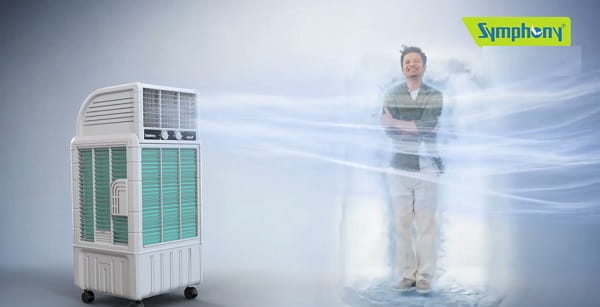
Symphony is not merely India’s top cooler brand — it is the world’s largest air cooler manufacturer by volume, selling products across more than 60 countries. Headquartered in Ahmedabad, Gujarat, Symphony has dominated India’s organised air cooler market for decades through relentless product innovation, an exceptionally wide model range spanning every price segment and room size, and a distribution network that ensures availability from metro showrooms to small-town appliance shops.
Symphony’s defining technology in 2026 is the i-Pure air filtration system, which adds a multi-stage air purification layer (including anti-bacterial and dust filtration) to the cooling function — transforming the cooler from a pure temperature-reduction device into a combined cooling-and-air-quality appliance. For buyers in polluted cities like Delhi, Gurgaon, and Lucknow, this air purification capability adds genuine value beyond temperature reduction alone.
The product range spans personal coolers (Diet series for small rooms), room coolers (HiCool series for medium spaces), and desert coolers (Sumo and Jumbo series for large halls and open areas). The Sumo 75 XL, with its 75-litre water tank and powerful blower, delivers sustained cooling across large living rooms and commercial spaces. BLDC energy-efficient motors, available across the premium lineup, reduce electricity consumption while maintaining strong airflow — a meaningful advantage for households running coolers 10-14 hours daily during peak summer.
Price range: ₹6,000-₹20,000. Best for: Overall best choice for most Indian buyers; widest model range across all room sizes; strong in both dry-heat and moderate-humidity regions.
2. Bajaj — Budget Performance and Durability
Bajaj Electricals brings the same value-focused philosophy to air coolers that it brings to ceiling fans: genuine performance and long-term durability at the most accessible price points available from a nationally recognised brand. For price-sensitive Indian families — and for the enormous number of buyers purchasing their first cooler — Bajaj consistently represents the smartest spending of limited cooling budgets.
The Bajaj DMH Neo series has emerged as a standout in 2026, with the DMH 65 Neo (65-litre tank, 90-foot air throw, anti-bacterial honeycomb pads) and DMH 90 Neo (90-litre tank for large halls and outdoor patios) both delivering performance that punches well above their price category. Bajaj’s industry-leading 3-year comprehensive warranty on the DMH Neo series is the best in the desert cooler segment — a genuinely important differentiator for buyers who want assurance that the motor and pump (the two components most likely to fail) are covered for extended periods of heavy seasonal use.
Bajaj desert coolers are specifically engineered for the extreme dry heat of North and Central India — regions where temperatures routinely exceed 45°C for weeks at a stretch and where cooler performance is tested most aggressively. The brand’s long air-throw capability (90 feet on larger models) ensures that cooling reaches across genuinely large spaces, making Bajaj desert coolers practical for drawing rooms, shops, and semi-outdoor spaces.
Price range: ₹4,000-₹13,000. Best for: Budget-conscious families, first-time buyers, large room cooling, Tier-2 and Tier-3 cities, buyers who prioritise warranty coverage.
3. Crompton — Maximum Airflow for the Money
Crompton brings the same engineering reliability that defines its ceiling fan business to the air cooler category, with a specific strength in high-CFM (cubic feet per minute) airflow that delivers genuinely powerful cooling across large rooms and halls. The Crompton Optimus series consistently ranks among the highest-airflow desert coolers available in the Indian market, making Crompton the default recommendation for buyers who specifically need to cool large living spaces, commercial areas, or multi-room open floor plans.
Crompton coolers feature honeycomb cooling pads as standard (superior to older wood-wool pads in both cooling efficiency and longevity), inverter-compatible motors (enabling operation during power cuts through home inverters), and durable construction that handles the sustained daily use Indian summers demand. The brand’s large tank capacities (50-90 litres across the desert cooler range) support 8-12 hours of continuous operation without refilling — a practical advantage during the peak afternoon hours when cooler use is most intensive and refilling is most inconvenient.
The value proposition is consistent: Crompton typically delivers the highest airflow per rupee spent of any major brand, making it the practical choice for buyers who prioritise raw cooling power and coverage area over design aesthetics or advanced smart features.
Price range: ₹5,000-₹14,000. Best for: Large rooms and halls requiring maximum airflow, commercial and semi-outdoor spaces, buyers prioritising cooling performance over design.
4. Havells — Premium Design with Silent Operation
Havells entered the air cooler market later than Symphony, Bajaj, and Crompton, but has rapidly established itself as the premium choice for buyers who want their cooler to be both effective and aesthetically compatible with modern home interiors. Where traditional desert coolers are bulky, industrial-looking appliances designed purely for function, Havells coolers bring the same design sensibility the brand applies to its lighting and fan products.
The Havells Breatheezee Technology is the brand’s defining feature — a multi-layer air purification system combining a dust filter, anti-bacterial mesh, and activated carbon layer that cleans cooled air before it enters the room. For families with respiratory sensitivities, allergies, or young children, this air purification capability represents genuinely meaningful health value beyond what standard cooler brands offer.
Havells coolers also consistently deliver the quietest operation among major brands — a product of the premium motor engineering that defines Havells’ broader appliance philosophy. The auto-drain function, which removes stagnant water from the tank to prevent bacterial growth and mosquito breeding, addresses a genuine maintenance pain point that cheaper coolers leave entirely to the user.
Price range: ₹7,000-₹18,000. Best for: Design-conscious urban buyers, families with respiratory sensitivities, premium apartments where cooler appearance matters, quiet bedroom operation.
5. Voltas — Tata Group Trust and Reliable Performance
Voltas extends its strong presence in the Indian cooling market from air conditioners to air coolers, bringing the Tata Group brand trust and India’s widest cooling appliance service network to a mid-range cooler lineup that balances feature depth with practical reliability. For buyers who specifically value after-sales service accessibility — the confidence of knowing that if something goes wrong, help is genuinely available nearby — Voltas’ service infrastructure provides reassurance that smaller cooler brands cannot match.
Voltas coolers feature inverter-compatible motors, multi-speed settings, and cooling pads designed for easy maintenance and replacement. The brand offers both compact room coolers for smaller spaces and larger-capacity models for open-plan living areas, though its desert cooler range is somewhat narrower than Symphony’s or Bajaj’s extensive lineups.
The practical advantage of Voltas in smaller cities and towns is significant: the same service network that supports Voltas AC installations and maintenance also handles cooler service, meaning that even in Tier-3 locations where cooler-specific brands may lack service presence, Voltas can provide reliable after-sales support through its broader Tata infrastructure.
Price range: ₹5,000-₹15,000. Best for: Buyers prioritising after-sales service reliability, Tata Group brand trust, mid-range budget with solid feature expectations.
FAQs
Q: Which cooler brand is best for dry heat regions like Rajasthan and Delhi?
A: Symphony and Bajaj are the top recommendations for extreme dry heat. Symphony’s larger desert cooler range (Sumo, Jumbo series) and Bajaj’s DMH Neo series with 90-foot air throw are specifically engineered for regions where temperatures routinely exceed 45°C for sustained periods.
Q: Do air coolers work in humid cities like Mumbai and Chennai?
A: Air coolers are significantly less effective in humid climates because evaporative cooling requires dry air to work properly. In coastal cities with humidity above 60-70%, coolers add moisture to already-humid air, reducing cooling effectiveness and potentially creating uncomfortable dampness. For humid regions, air conditioning is generally the more practical cooling solution.
Q: How much electricity does an air cooler consume compared to an AC?
A: Air coolers typically consume 150-300 watts depending on size and model, compared to 1,500-2,500 watts for an air conditioner. This makes coolers roughly one-eighth to one-tenth the electricity cost of an AC, translating to dramatically lower monthly electricity bills during summer.
Q: How often should I change the cooling pads in my cooler?
A: Honeycomb cooling pads typically last 2-3 seasons with proper care. Replace them when you notice reduced cooling efficiency, visible mineral buildup, or deterioration. Clean pads monthly during active use by rinsing with water. Wood-wool pads need more frequent replacement and are generally inferior to honeycomb alternatives.
Q: Can air coolers run on home inverters during power cuts?
A: Yes, most modern coolers with inverter-compatible motors can run on home inverters. Check the cooler’s wattage against your inverter’s capacity before purchase. BLDC-motor coolers from brands like Symphony consume less power and are more inverter-friendly than conventional motor models.