The pressure cooker is quite possibly the most essential single piece of kitchen equipment in Indian cooking — present in virtually every Indian household regardless of income level, region, or culinary tradition. From the morning dal to the evening rice, from rajma to biryani, from simple khichdi to elaborate mutton curry, the pressure cooker handles the daily cooking workload of hundreds of millions of Indian kitchens with a speed and fuel efficiency that no other cooking vessel can match. The characteristic whistle of a pressure cooker has become, for generations of Indians, the ambient soundtrack of home cooking itself.
In 2026, the Indian pressure cooker market features several established brands with decades of presence alongside newer entrants pushing design and material innovation. But the core question for most buyers remains straightforward: which brand will cook reliably, last for years without safety concerns, and provide easily accessible spare parts (gaskets, weight valves, handles) when maintenance is inevitably needed? The five brands below represent the most trusted answers to this question.
1. Hawkins — The Gold Standard of Indian Pressure Cookers
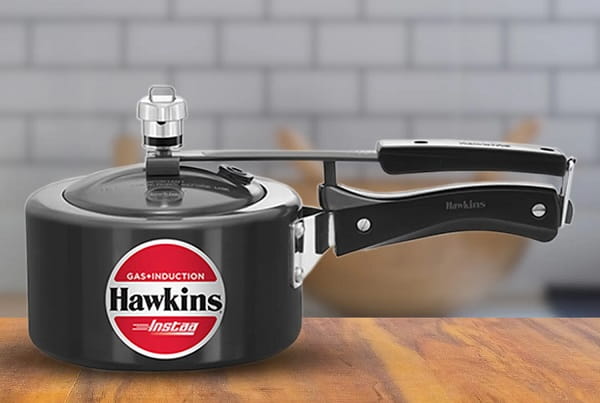
Hawkins has been manufacturing pressure cookers since 1959 and has sold over 100 million cookers worldwide — numbers that reflect a level of sustained consumer trust that few Indian consumer brands of any category can match. When experienced cooks, professional chefs, or kitchen appliance reviewers are asked to name the single most durable, safest, and most reliably constructed pressure cooker available in India, Hawkins is consistently the first name mentioned.
Hawkins’ defining engineering feature is its inside-fitting lid design — the lid sits inside the rim of the cooker body rather than on top of it, creating an inherently safer pressure seal that is virtually leak-proof during cooking. The pressure lock mechanism, compared by the company to a jetliner door design, ensures that the lid physically cannot be opened until steam pressure inside reaches safe levels — a genuine safety advantage over outer-lid designs where improper handling can theoretically allow the lid to be forced open under pressure.
The product range spans multiple material categories: the classic aluminium Miss Mary and Classic series (lightweight, fast-heating, starting from approximately ₹1,125 for a 3-litre model), the hard anodised Contura series (more durable, non-reactive, with a distinctive curved body that facilitates stirring), and stainless steel models offering food-grade hygiene and induction compatibility. Every Hawkins cooker carries a 5-year warranty and ISI certification, with spare parts — gaskets, weight valves, safety plugs — available at virtually every kitchen shop in India, a practical advantage that cannot be overstated for a product that requires periodic rubber gasket replacement.
Price range: ₹1,100-₹4,500. Best for: Curries and gravies (where the inner-lid design prevents spillage), long-term durability, safety-conscious buyers, professional and semi-professional kitchens.
2. Prestige — India’s Most Innovative Kitchen Brand
Prestige, operated by TTK Prestige Limited, has emerged as India’s largest kitchen appliance company and the brand most consistently associated with pressure cooker innovation. While Hawkins has built its reputation on engineering perfection of a fundamentally traditional design, Prestige has progressively introduced features that solve specific, real-world cooking pain points that traditional cookers have historically left unaddressed.
The Svachh lid technology is Prestige’s most significant innovation — a deep lid design that catches and contains the starchy spillage that pressure cookers notoriously release through the vent weight during dal and rice cooking, keeping the cooktop clean. Anyone who has scrubbed dried dal residue from around a conventional pressure cooker after every use understands why this innovation has genuine daily value. The Svachh lid simply collects the residue inside the lid itself, which is emptied and rinsed after cooking — a small but genuinely transformative quality-of-life improvement for daily Indian cooking.
Prestige now offers a 10-year warranty on stainless steel models (up from 5 years in previous generations), reflecting confidence in build quality that competitors have been pressed to match. The Nakshatra Duo design cleverly combines an aluminium body (for fast heating) with a stainless steel inner lid (for hygiene and durability), offering genuine best-of-both-worlds construction.
The Prestige Deluxe Alpha stainless steel model is widely recommended as the best single pressure cooker for most Indian families — combining an outer-lid design (easier for rice cooking and starch draining), induction compatibility, a controlled gasket release safety system, and the build quality to last 15-20 years.
Price range: ₹1,200-₹4,000. Best for: Rice cooking (outer-lid design allows easy starch draining), innovation-focused buyers, families who value Svachh spillage control, induction-compatible kitchens.
3. Pigeon (by Stovekraft) — India’s Best-Selling Budget Brand
Pigeon, operated by Stovekraft Limited, occupies the budget segment of the Indian pressure cooker market with a combination of genuinely accessible pricing and adequate-for-daily-use performance that has made it the most widely purchased pressure cooker brand in India by unit volume. The Pigeon Favourite 3-litre aluminium model is found in millions of Indian kitchens — a lightweight, fast-heating, outer-lid cooker with a precision weight valve and metallic safety plug, available at approximately ₹800-1,000.
Pigeon’s value proposition is straightforward: for the majority of Indian households cooking simple daily meals — dal, rice, khichdi, basic sabzis — a Pigeon pressure cooker delivers the necessary function at a price point that makes it genuinely accessible to even the most budget-constrained buyers. The brand doesn’t attempt to compete with Hawkins or Prestige on premium build quality or innovative features; instead, it focuses specifically on making reliable, ISI-certified pressure cooking available at the lowest possible cost.
The Pigeon Inox stainless steel range extends the brand into slightly more premium territory, with induction-compatible models offering improved durability and hygiene at price points still meaningfully below Hawkins and Prestige equivalents. The Pigeon Special Stainless Steel Combo pack — offering multiple cooker sizes at a single bundled price — represents exceptional value for new households setting up their kitchens from scratch.
Price range: ₹800-₹2,500. Best for: Budget-conscious buyers, first-time households, student kitchens, basic daily cooking needs, multi-cooker purchases on limited budgets.
4. Butterfly — South India’s Preferred Kitchen Brand
Butterfly Gandhimathi Appliances has built a particularly strong presence in South Indian kitchens, where its pressure cookers, mixer grinders, and gas stoves have become household staples across Tamil Nadu, Karnataka, Kerala, and Andhra Pradesh. The brand’s distribution and service network in South India specifically exceeds many national competitors, providing a practical after-sales advantage that matters for a product requiring periodic gasket and valve replacement.
Butterfly’s pressure cooker construction emphasises sturdiness and even heat distribution, with sandwich-bottom designs on stainless steel models that prevent hotspots and ensure uniform cooking — particularly important for South Indian staples like sambar, rasam, and pongal that require slow, even simmering under pressure. The Butterfly Cordial series offers a range of sizes in both aluminium and stainless steel at competitive price points, positioned between Pigeon’s budget segment and Prestige’s premium range.
The brand’s strength lies not in revolutionary features but in consistent, reliable construction quality specifically optimised for South Indian cooking patterns — a focused positioning that has earned deep loyalty within its primary market geography.
Price range: ₹1,200-₹3,000. Best for: South Indian households, sambar and rasam cooking, buyers in Tamil Nadu, Karnataka, Kerala, and Andhra Pradesh where Butterfly’s service network is strongest.
5. Wonderchef — The Modern Design Innovator
Wonderchef, founded by celebrity chef Sanjeev Kapoor, represents the newest generation of Indian pressure cooker brands — bringing contemporary design, premium materials, and health-conscious cooking philosophy to a category historically dominated by purely functional products. For urban, design-aware buyers who want their pressure cooker to look attractive on an open kitchen shelf rather than hidden inside a cabinet, Wonderchef offers an aesthetic upgrade that traditional brands haven’t historically prioritised.
The Wonderchef Nutri-Pot series features multi-functional pressure cooking with preset programmes for different food types, bringing a degree of automation that appeals to younger, less experienced home cooks. The Taurus range offers triply stainless steel construction at competitive pricing, while the brand’s ceramic-coated and non-stick pressure cooker options reflect consumer interest in healthier cooking with less oil — an increasingly important purchase consideration for health-conscious urban Indian buyers.
Wonderchef’s positioning occupies a genuinely different space from the legacy brands above: where Hawkins and Prestige have built decades-long trust through proven durability and engineering reliability, Wonderchef appeals to a newer generation of home cooks who approach cooking as a creative and lifestyle activity rather than purely a daily domestic obligation.
Price range: ₹2,000-₹5,000. Best for: Design-conscious urban buyers, younger home cooks, health-focused cooking with reduced oil, buyers who value modern aesthetics in kitchen appliances.
How to Choose the Right Pressure Cooker
The material decision comes first: aluminium is lighter, heats faster, and costs less, but lasts 8-10 years and reacts with acidic foods (tamarind, tomato). Stainless steel is heavier, more expensive, but lasts 15-20 years, is dishwasher-safe, and doesn’t react with any food — the better long-term investment. Hard anodised aluminium offers a middle ground with improved durability over regular aluminium.
Choose inner-lid (Hawkins-style) for curries, gravies, and leak-proof cooking. Choose outer-lid (Prestige-style) for rice and dishes where starch draining is needed. ISI certification is non-negotiable — it confirms the cooker meets Bureau of Indian Standards safety requirements. Replace gaskets every 12-18 months of regular use, and always buy genuine brand-specific replacements.
FAQs
Q: Which is better — Hawkins or Prestige pressure cooker?
A: Both are excellent but serve slightly different preferences. Hawkins’ inner-lid design is inherently safer and better for curries and gravies. Prestige’s outer-lid design is easier for rice cooking and starch draining. Prestige’s Svachh technology solves the spillage problem. Hawkins’ build quality is marginally more robust in many comparisons. For most Indian kitchens, having one of each type is the ideal setup.
Q: How often should I replace the gasket in my pressure cooker?
A: Every 12-18 months with regular use, or immediately if you notice steam leaking from the lid sides, visible cracks, hardening, or permanent deformation. A worn gasket reduces cooking efficiency and can be a safety concern. Always buy genuine brand-specific replacement gaskets.
Q: Is stainless steel better than aluminium for pressure cookers?
A: For long-term investment, yes. Stainless steel lasts 15-20 years, doesn’t react with acidic foods, is dishwasher-safe, and works on induction cooktops. Aluminium heats faster, is lighter, and costs less but lasts only 8-10 years and can react with acidic ingredients over time.
Q: Can I use a pressure cooker on an induction cooktop?
A: Only if the cooker has an induction-compatible base — typically stainless steel with a magnetic bottom layer. Check the product specifications before purchasing. Most stainless steel models from Prestige, Hawkins, and Pigeon offer induction-compatible variants.
Q: What size pressure cooker should I buy for my family?
A: For 2-3 people, a 3-litre cooker handles daily dal and rice. For 4-5 people, a 5-litre is the most versatile size. For larger families or batch cooking, a 7-9 litre cooker provides adequate capacity. Many experienced home cooks recommend owning two sizes — a 3-litre for everyday small meals and a 5-litre for main family cooking.